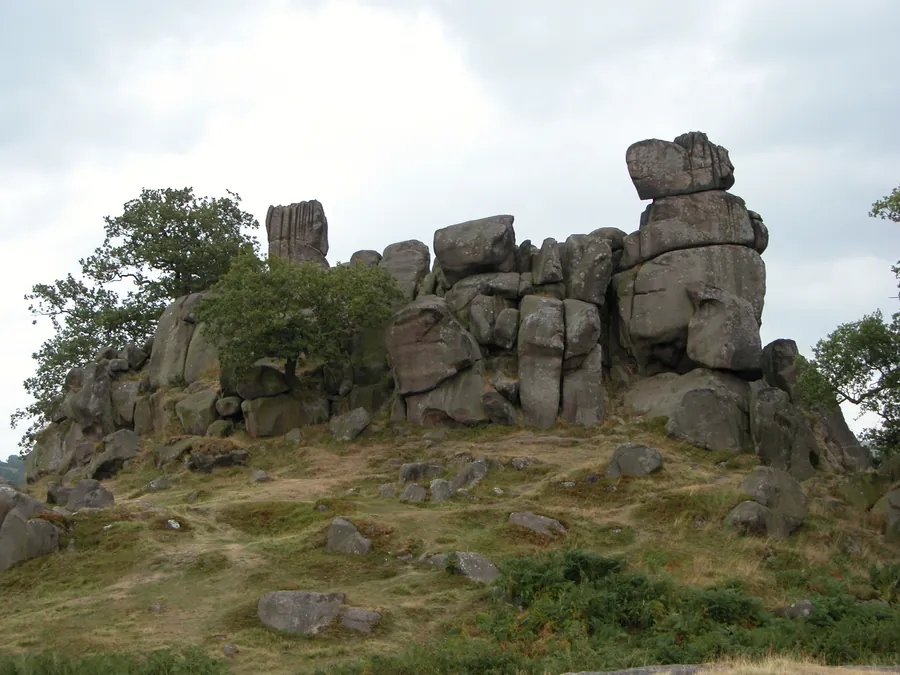
Robin Hood’s Stride is a knot of weathered gritstone standing on the ridge above the village of Elton, six kilometres south of Bakewell. Two tall pinnacles rise from a jumble of deeply seamed boulders, and the whole thing looks, from a distance, like the ruin of something built.
The name comes from a fourteenth-century legend that Robin Hood strode from one pinnacle to the other. They are about seventeen metres apart, which puts the story in perspective. The pinnacles have their own names: Weasel and Inaccessible.
The outcrop itself is the attraction — for scrambling, for climbing, and for the view south over the limestone country towards Matlock and the Derwent valley. The rock is fissured and water-carved into shapes that reward wandering about in, and children climb on the lower boulders happily for an hour.
Serious climbers use the pinnacles; the routes on them are short and old.
This is the point. Robin Hood’s Stride sits in one of the densest concentrations of prehistory in the Peak District, and everything below is within a few hundred metres.
Nine Stones Close — a stone circle of which four stones survive, and they are the tallest standing stones in Derbyshire. It sits in a field just below the Stride, and the alignment between the circle and the pinnacles is the sort of thing that generates a good deal of speculation.
The Portway — an ancient trackway, possibly prehistoric and certainly long pre-Roman in parts, running past the outcrop. It was one of the principal routes across the Peak.
Cratcliffe Tor and the Hermit’s Cave — a rock shelter under the tor a short walk east, containing a crucifix carved into the rock face, stylistically dated to the thirteenth or fourteenth century, with a niche beside it. It is inside a fenced enclosure protecting a yew tree and can be a little awkward to find. It is remarkable, and almost nobody goes.
Rowtor Rocks at Birchover, a kilometre away, is a further gritstone outcrop carved in the eighteenth century by a local clergyman with steps, seats and rooms cut into the rock.
Robin Hood’s Stride is on the Limestone Way, the long-distance path running from Castleton to Rocester.
The standard circuit starts from the roadside parking on the Elton to Alport road, takes in the Stride, Nine Stones Close, Cratcliffe Tor and the Hermit’s Cave, and returns via Birchover or the Portway. Around five kilometres and two hours.
Longer options link to Stanton Moor — with the Nine Ladies stone circle among the birch — two kilometres east, making one of the best prehistoric days in the Peak District.
Free, open access, with no facilities.
Parking: a small lay-by on the Elton road, with room for a few cars. It fills at weekends.
Terrain: field paths and rough grass, with a short climb to the outcrop. The rocks themselves are a scramble.
Care: the pinnacles are climbable and people fall off them. The lower boulders are fine; the tops are for climbers.
Season: any. The heather and the light in late summer and autumn are the best of it, and the site is atmospheric in mist.
By car: signposted lanes from Elton or Birchover, off the B5056 south of Bakewell.
On foot: the Limestone Way from Youlgreave, about four kilometres.
By bus: limited services to Elton and Birchover; check timetables.
From a fourteenth-century legend that Robin Hood strode between the two pinnacles, which are about seventeen metres apart.
A stone circle just below the outcrop, of which four stones survive — the tallest standing stones in Derbyshire.
A rock shelter under nearby Cratcliffe Tor with a crucifix carved into the rock face, dated to the thirteenth or fourteenth century.
Yes, entirely — open access land with roadside parking.
About five kilometres and two hours for the circuit taking in the Stride, the stone circle and the Hermit’s Cave.