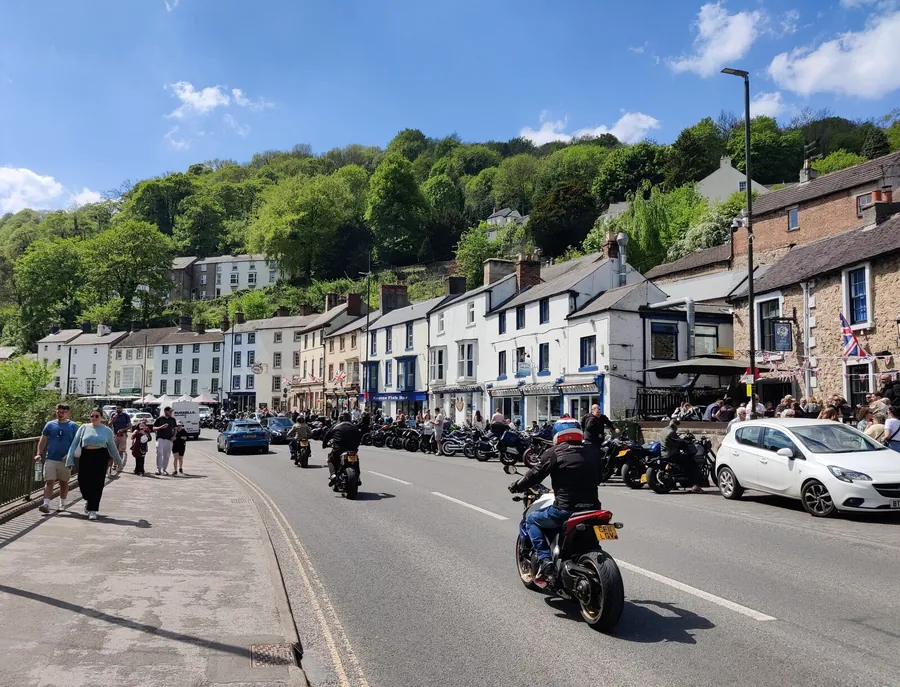
Matlock Bath is a village and civil parish in the Derbyshire Dales, on the main A6 road south of Matlock and roughly halfway between Buxton and Derby. The population of the parish at the 2011 census was 753. The Derwent runs through a valley too steep to build on both sides: most of the buildings stand on one bank, and the only crossings are footbridges.
It is the trip out of Bakewell that is least like Bakewell. Warm springs found in 1698 made the place a spa, the 19th century turned the spa into a resort, and what is left is a resort strip along a river — arcades, an aquarium, gardens and a pavilion on the valley floor, and a cable car lifting out of the gorge to caverns and viewpoints above.
The straight-line distance from Bakewell is 13.7 km.
The village was originally built at the head of a dead-end dirt road running along the Derwent valley from Matlock. That road was later upgraded into a through route — the present A6 — replacing the old coaching approach to Matlock from Cromford over very steep hills near the Riber plateau. What history left is a long frontage rather than a square or a green: the village is a designated conservation area with an Article 4 direction on properties, predominantly along North and South Parade.
On the flat ground by the water are Derwent Gardens, 4.5 from 276 Google reviews, and Lovers’ Walks, 4.6 from 271 — both small samples — plus the Grand Pavilion and the aquarium and amusement arcade. The aquarium carries 4.3 from 2,177 Google reviews and divides people sharply. A visitor in August 2026 wrote, “Extremely disappointing and not worth the money”, and one in July 2026 that “you are literally in there for ten minutes and that’s dragging it out.” Others rate it top marks. Treat it as an arcade with fish rather than an afternoon.
On Sundays in summer many hundreds of motorcyclists congregate here. In autumn the “Venetian Nights” are held, with illuminations along the river and illuminated boats.
The Heights of Abraham is the attraction the village is known for, 4.5 from 4,420 Google reviews. Its cable cars link the base of High Tor and rise to the park above, and reviewers single the ride out: a visitor in July 2026 wrote, “The cable car ride itself is unique in England and gives a flavour of the alps in miniature.”
Up top are the show caverns. The Great Masson Cavern carries 4.7 from 1,966 Google reviews, the highest rating of the paid attractions here. It is not a level stroll: stairs, slopes and caves rather than paths. A visitor in July 2026 put it plainly: “You need to be reasonably fit for this.” Another, in August 2026, was honest about value: “It’s not really a repeatable experience as you can easily see everything in a day, but well worth a visit.”
On the opposite bank of the Derwent stands High Tor, a sheer cliff used by climbers and walkers, with Giddy Edge — a narrow winding path along the cliff edge. The climbing here is serious rather than casual: the cliffs at High Tor, Pic Tor, Willersley Castle Rocks and Wildcat crags are generally unequipped, climbed in traditional style, placing protection as you go. The river is a canoeing venue: Matlock Canoe Club hosts national-level wild-water racing and slalom events here.
The Peak District Lead Mining Museum, listed as the Peak District Mining Museum at 4.7 from 519 Google reviews, is the indoor counterweight to the caverns and the arcades, and the smallest of the village’s attractions by review count.
Gulliver’s Kingdom, a theme park built into the hillside, carries 4.3 from 4,362 Google reviews and is squarely for younger families. A visitor in August 2026 wrote, “The park is well suited for younger children, and the staff were friendly, helpful, and supportive throughout our visit,” while adding the criticism that recurs in its reviews: “The quality was disappointing, and there wasn’t enough availability or variety” of food. It is a full day in itself, not an add-on to an afternoon in the village.
The bath house came first, built after the warm springs were discovered in 1698. As the waters became better known, access improved: a bridge was built into Old Matlock, and in 1783 a new entrance opened at the south of the valley. Princess Victoria of Kent’s royal visit in 1832 confirmed Matlock as a society venue of its day; her party went to a pair of museums and a petrifying well. John Ruskin and Lord Byron came, and Byron’s comparison with alpine Switzerland gave the place its nickname, Little Switzerland. Erasmus Darwin recommended the area to Josiah Wedgwood I for its beauty and soothing waters, and members of both families holidayed and settled here.
Rail brought the crowds before it reached the valley: when the North Midland Railway opened in 1840, carriages plied for hire from Ambergate station, and the Birmingham and Derby Junction Railway ran excursions carrying passengers onward from Ambergate by the Cromford Canal. Matlock Dale, a hamlet about 0.5 miles (0.8 km) north, gives its name to that stretch of the river valley.
Matlock Bath has a railway station, built in 1849 on the Midland Railway line between London and Manchester, and it is little use to you from Bakewell. The section from Matlock to Buxton closed in 1968 in the Beeching cuts, taking the through route north with it; today East Midlands Railway runs generally hourly each way between Matlock and Derby on the Derwent Valley Line, so trains approach from the south. Bakewell’s own line closed in 1968 as well. The station sits 12.9 km from the Bakewell centre point and carries 4.5 from 88 Google reviews.
That leaves the road: the A6 runs from Bakewell through Matlock and on into Matlock Bath, immediately south of Matlock. No direct bus between the two is established in the sources for this guide — the Transpeak service is documented as linking Matlock with Bakewell, but not as continuing into Matlock Bath — so check the timetable rather than assuming a through service.
The village and what is around it, at walking scale.
Open any of them in Google Maps for directions and current opening.
Want live prices and dates? GetYourGuide's booking widget shows them, and sets their cookies in your browser when it loads.
Background on Matlock Bath draws on its Wikipedia article, text there being available under CC BY-SA 4.0.