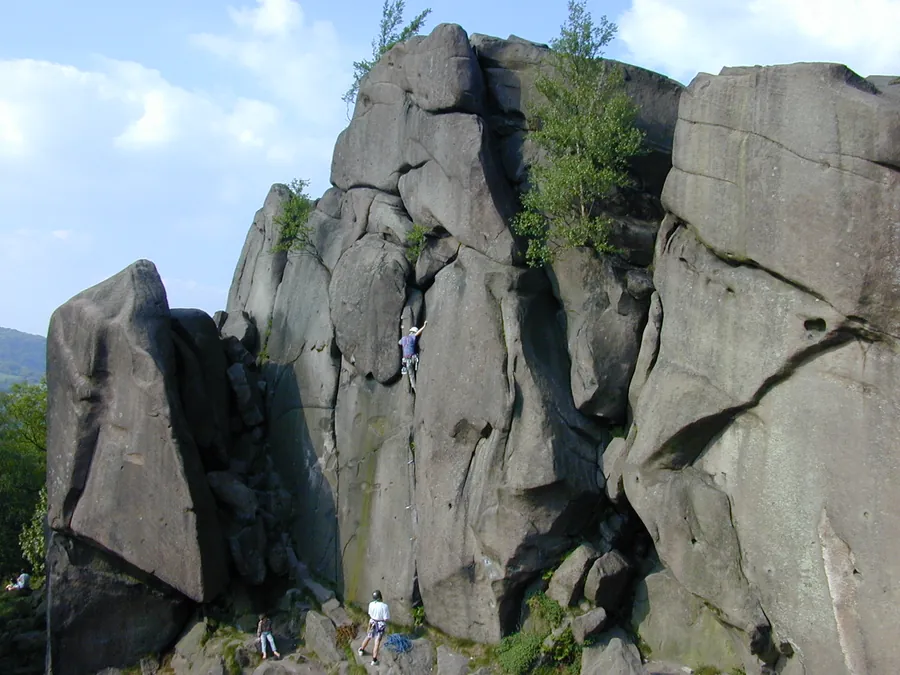
Black Rocks — sometimes Stonnis Rocks — is an outcrop of ashover gritstone standing above the Derwent valley between Cromford and Wirksworth, fifteen kilometres south of Bakewell. It is a modest-looking cluster of dark rock at the top of a wooded hill, and it has a significance in British climbing out of all proportion to its size.
Black Rocks has been climbed on since the nineteenth century and it is one of the historically important crags in the country. John Ruskin wrote about it; generations of Derbyshire and Sheffield climbers learned here.
Its modern reputation rests on the hard slabs. Gaia, first climbed in 1986 and graded E8 6c, is among the most famous and most attempted extreme routes in Britain — a bold, poorly protected line that has been the subject of films, books and a great many failed attempts. If there are people standing about at the base of a slab looking upwards for a long time, that is usually what they are looking at.
For non-climbers, watching is free and frequently gripping.
The outcrop sits in Black Rocks plantation, a Forestry England wood with waymarked trails from a car park at the top.
To the rocks themselves: a few minutes from the car park on a good path, with a scramble onto the top of the outcrop for the view.
The view is the reason most people come: the Derwent valley below, Cromford and its mills, the Matlock hills, and a long way south over the lowlands.
The forest trails run for several kilometres through conifer and broadleaf, with easy family routes and mountain bike lines. There is a sculpture trail and a viewpoint circuit.
The High Peak Trail passes directly beside the car park — a level, surfaced former railway running along the top of the ridge, which links Black Rocks to Middleton Top and its restored winding engine, and eventually to Parsley Hay and the Tissington Trail. Level cycling and walking for as far as you want it.
The other reason to come this way. Cromford, a kilometre down the hill, is where Richard Arkwright built the world’s first successful water-powered cotton spinning mill in 1771 — the birth of the factory system — and the Derwent Valley Mills are a UNESCO World Heritage Site because of it.
Cromford Mills has exhibitions, shops and a café. The Cromford Canal and High Peak Junction — where the canal met the railway — are free walking, and the Leawood Pump House occasionally steams.
Black Rocks and Cromford together make a very good day: an hour on the rocks for the view, then down the hill into the Industrial Revolution.
Free, apart from parking at the Black Rocks car park.
Facilities: toilets and a seasonal refreshment point at the car park.
Access: the main path from the car park to the viewpoint is short and reasonably surfaced; the rocks themselves are a scramble and the forest trails are rougher.
Care: the top of the outcrop has unfenced drops. Keep children close.
Season: any. The view is best on a clear winter day.
By car: signposted from the B5036 above Cromford, fifteen kilometres south of Bakewell. There is a car park at the top, which saves the climb.
On foot: steeply up from Cromford, about a kilometre.
By train: Cromford has a station on the Derwent Valley line from Derby to Matlock, and the walk up takes twenty minutes.
By bike: along the High Peak Trail, which runs past the car park.
An extreme rock climb on Black Rocks, first climbed in 1986 and graded E8 6c — one of the most famous hard routes in Britain.
No. The walk from the car park to the viewpoint takes a few minutes and the view over the Derwent valley is the main draw for most visitors.
Yes, apart from the car park at the top.
Cromford Mills and the Derwent Valley Mills World Heritage Site, a kilometre down the hill, and the level High Peak Trail past the car park.
Fifteen kilometres south, about twenty-five minutes by road.