Haddon Hall stands on a wooded rise above the River Wye, three kilometres south of Bakewell, and it has a reasonable claim to being the most important house of its kind in England. Pevsner’s description — “the most complete and most interesting house of its period” — is quoted so often locally that it has become a slogan, but it is also true.
The reason is neglect. The Manners family, later Dukes of Rutland, moved their principal seat to Belvoir Castle in the early eighteenth century and Haddon was left largely alone for two hundred years. It was never Georgianised, never Victorianised, never rebuilt for fashion. When the ninth Duke began restoring it in the 1920s, what he restored was a medieval and Tudor house that had simply stopped.
The origins are eleventh-century, with additions in almost every century between the thirteenth and the seventeenth, the latest of them Tudor.
The Banqueting Hall is the fourteenth-century heart of it: a screens passage, a minstrels’ gallery, a dais and a long oak table.
The kitchens beyond are among the best-preserved medieval domestic kitchens anywhere in England — the chopping blocks, the salting troughs and the fireplaces are all in place.
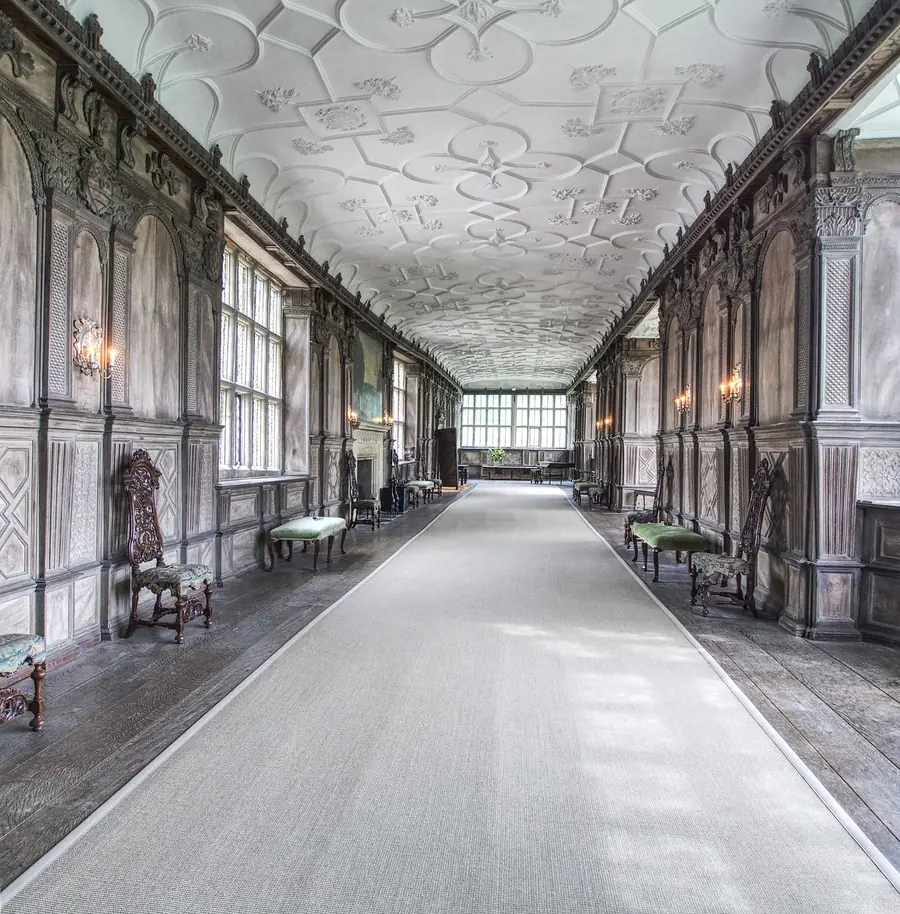
The Long Gallery, added in the Elizabethan period, runs 110 feet with light coming through leaded windows that are visibly out of true, and it is generally reckoned one of the loveliest rooms in the country.
The chapel has wall paintings of the fifteenth century, uncovered under limewash.
The courtyards, the gatehouse and the tower give the whole thing the look of a small fortified village rather than a country house.
Terraced, dropping in stages from the house to the river, with roses, clipped yew and a seventeenth-century balustrade. They are formal without being grand and they were laid out to be walked in rather than looked at from above.
The famous view is from the bottom of the steps looking back up at the house, and the packhorse bridge over the Wye below it.
Haddon’s completeness has made it one of the most-filmed houses in Britain — several versions of Jane Eyre, Elizabeth, The Princess Bride and The Other Boleyn Girl among a long list. If it looks familiar, that is why.
Season: open for a defined season with variable days — typically spring to autumn plus a Christmas opening, which is a substantial event with the hall dressed and market stalls in the courtyard. Check dates before travelling; this is not a house that opens every day.
Admission is at the upper end for a house of this size. Most visitors judge it worth it; a few do not, and the honest answer is that what you are paying for is authenticity rather than acreage.
Time: two hours for house and gardens, longer at Christmas.
Accessibility: it is a medieval house on a slope, with steps, uneven floors and no lift. The lower courtyard and part of the gardens are more manageable; contact the estate in advance.
Facilities: a restaurant in the stables, a shop, and toilets.
On foot from Bakewell: three kilometres along the Wye, leaving the town by the Recreation Ground. Around forty minutes, and much the best approach — the house appears across the meadows.
By car: on the A6 south of Bakewell, with a car park.
By bus: services between Bakewell and Matlock stop at the gate.
Because it was never modernised. The family moved out in the eighteenth century and the house survived as a medieval and Tudor building rather than being rebuilt for later fashion.
The origins are eleventh-century, with additions between the thirteenth and seventeenth centuries.
No. It opens for a defined season with variable days, plus a Christmas opening. Check dates before travelling.
Yes — three kilometres along the River Wye, about forty minutes, and the best way to arrive.
No. Chatsworth, four kilometres north-east, is a vast baroque palace; Haddon is a medieval manor house. They are entirely different visits and both are worth doing.