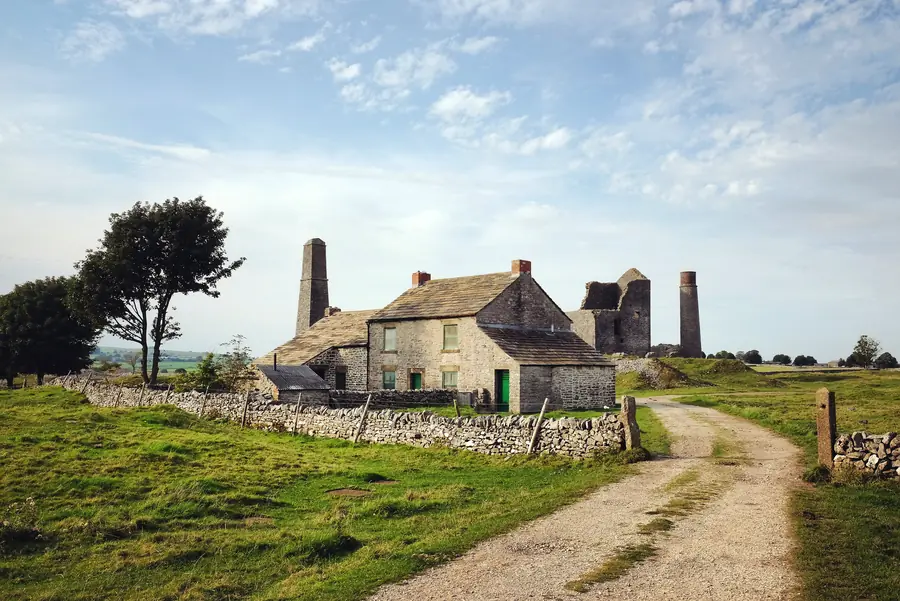
Magpie Mine sits on open ground near the village of Sheldon, four and a half kilometres west of Bakewell, and it is the best-preserved lead mine in Britain. A walled enclosure on the limestone plateau containing an engine house, a chimney, a winding house, the headgear over the main shaft and a scatter of ancillary buildings — all of it standing, none of it restored into tidiness.
It is a Scheduled Monument, it is free, it is open at all hours, and on a wet afternoon with the cloud down there is nowhere in the Peak District quite like it.
Lead has been mined in Derbyshire since Roman times, and Magpie is the survivor. Records of working here go back to the 1740s and the mine operated intermittently until 1958, which makes it one of the last lead mines in the county.
The buildings you see are mostly nineteenth-century:
The Cornish engine house and chimney — the tall structure that dominates the site, built in the 1860s to house a pumping engine, in the Cornish style because Cornish engineers built these things everywhere.
The winding house and headgear over the main shaft, which goes down 220 metres.
The agent’s house and the smaller buildings, some of which are used by the Peak District Mines Historical Society, which looks after the site.
The horse gin circle, where a horse walked in a ring to raise ore before steam arrived.
The mine has a genuinely dark story attached, and it is the reason a good many people come.
Underground boundaries between adjacent lead mines were a permanent source of dispute, and in 1833 the disagreement between the Magpie miners and those of the neighbouring Maypitts mine turned into open conflict underground. The Magpie men lit fires to smoke out their rivals, and three Maypitts miners died of suffocation.
Twenty-four Magpie miners were tried for murder at Derby. All were acquitted — the defence argued successfully that it could not be established which side’s fires had killed the men.
The widow of one of the dead is said to have cursed the mine, and the persistent failure of Magpie to make anyone much money over the following century has been attributed locally to it ever since. The site is reputed to be haunted and is a fixture of Derbyshire ghost stories.
Free and open, at any time, with no facilities and no staff. It is a working landscape rather than an attraction.
Take care. This is a mine site with capped and open shafts, unstable stonework and unfenced ground. The shafts are secured but the site is not childproofed, and the Peak District Mines Historical Society asks visitors to stay out of the buildings and away from the workings. Keep children close and dogs on leads.
Time: thirty to forty minutes on site.
Photography: the reason many people come. Late afternoon and low winter sun on the engine house is the shot; the site also works well in mist, which it gets a good deal of.
By car: a lay-by on the Sheldon road with space for a few cars, then a short walk across a field. It is signposted but easy to miss.
On foot: the best approach is from Sheldon village, about a kilometre across the fields, or from Ashford in the Water, four kilometres. Walking to it across the plateau, with the chimney appearing over the wall line, is far better than parking beside it.
Circular walks link Magpie with Sheldon, Ashford and Deep Dale, and make a good half day.
Yes — free, unstaffed and open at all times. Only respect the shafts and the stonework.
Lead. Working is recorded from the 1740s and the mine operated intermittently until 1958.
An 1833 underground dispute with the neighbouring Maypitts mine in which three miners died of smoke inhalation. Twenty-four Magpie men were tried and acquitted.
No. The shafts are capped and secured, and the site should be viewed from the surface only.
A lay-by on the Sheldon road with a short field walk, or on foot from Sheldon or Ashford in the Water — the walk is much the better approach.