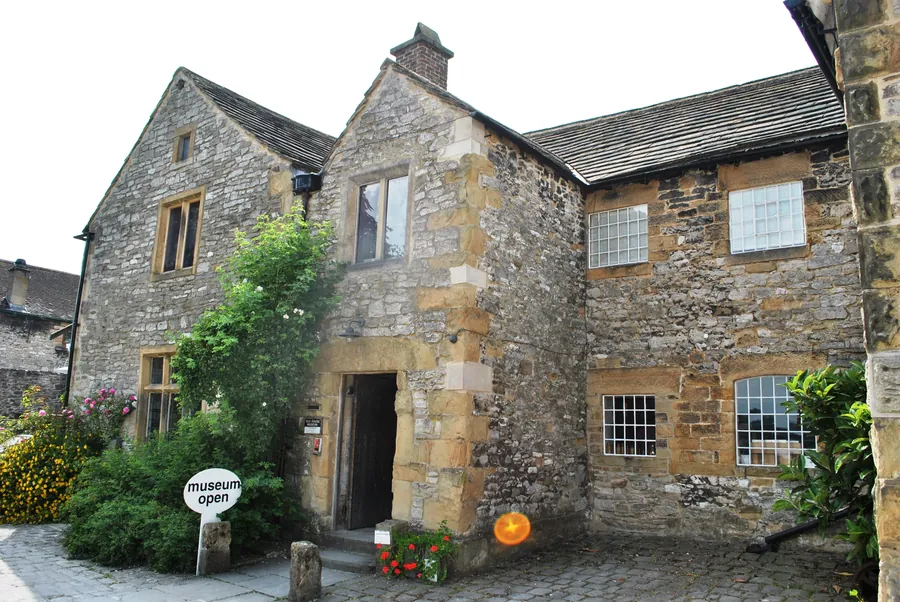
The Old House Museum sits on Cunningham Place, up a steep lane behind the parish church, and it is the oldest house in Bakewell. A sixteenth-century yeoman’s house — built around 1534, tax-assessed in the sixteenth century, later subdivided into workers’ cottages and very nearly demolished in the 1950s before a local group saved it.
It is a small museum and the building is the principal exhibit.
What makes it worth an hour is that the fabric has been left readable. The original timber frame is exposed in places, and you can see the wattle and daub infill, an original garderobe — a medieval indoor privy discharging outside the wall — and the marks of the successive alterations that turned a yeoman’s hall into a Georgian mill-worker’s tenement and back again.
Richard Arkwright, the cotton spinner, held the house at one point and converted it into accommodation for workers at his Bakewell mill, which is a neat connection between a Tudor farmhouse and the Industrial Revolution.
Local rather than grand, and better for it: Victorian and Edwardian domestic life, costume, toys, a nineteenth-century kitchen, lead mining and quarrying material, and a good deal on the town itself — the market, the trades and the arrival of the railway in 1862 that turned Bakewell into a day-trip destination.
There is also, inevitably, material on the Bakewell pudding, and the museum is a reasonable place to get the story straight before you go and eat one.
The volunteers who staff it are consistently singled out by visitors as the best thing about the place, which is often the case with small independent museums and is worth saying.
Time: an hour, perhaps ninety minutes.
Cost: modest, and by common consent good value.
Season: it is a volunteer-run museum with a defined season — broadly spring to autumn — and limited days. Check before travelling; this is not a museum that opens every day of the year.
Access: it is a Tudor house on a hill. There are steps up to it, low doorways, uneven floors and narrow stairs, and it is not wheelchair accessible.
Getting to the door: the direct route from the town is a steep lane. The gentler approach is through the churchyard of All Saints, which locals recommend and which avoids the worst of the climb.
Facilities: toilets on site; no café, but the town is two minutes away.
All Saints Church, immediately below, is free and holds a remarkable collection of Anglo-Saxon and Norman carved stones, including two crosses in the churchyard. The two together make a good morning, and both are within five minutes of the market square.
Bakewell’s car parks fill, particularly on Monday, which is market day, and on summer weekends. Visitors regularly report circling and giving up. The Recreation Ground and the old station car park are the largest; arrive early or come by bus.
On foot: three minutes uphill from the market square, or via the churchyard.
By bus: frequent services from Sheffield, Chesterfield, Derby, Matlock and Buxton stop around The Square.
By car: park in the town and walk; there is no parking at the museum.
It dates from around 1534, which makes it the oldest house in Bakewell.
Richard Arkwright held the house and converted it into accommodation for workers at his Bakewell cotton mill.
No. It is volunteer-run with a defined season and limited days — check before travelling.
No. It is a Tudor building with steps, low doorways and narrow stairs.
About an hour, and it pairs naturally with All Saints Church immediately below it.