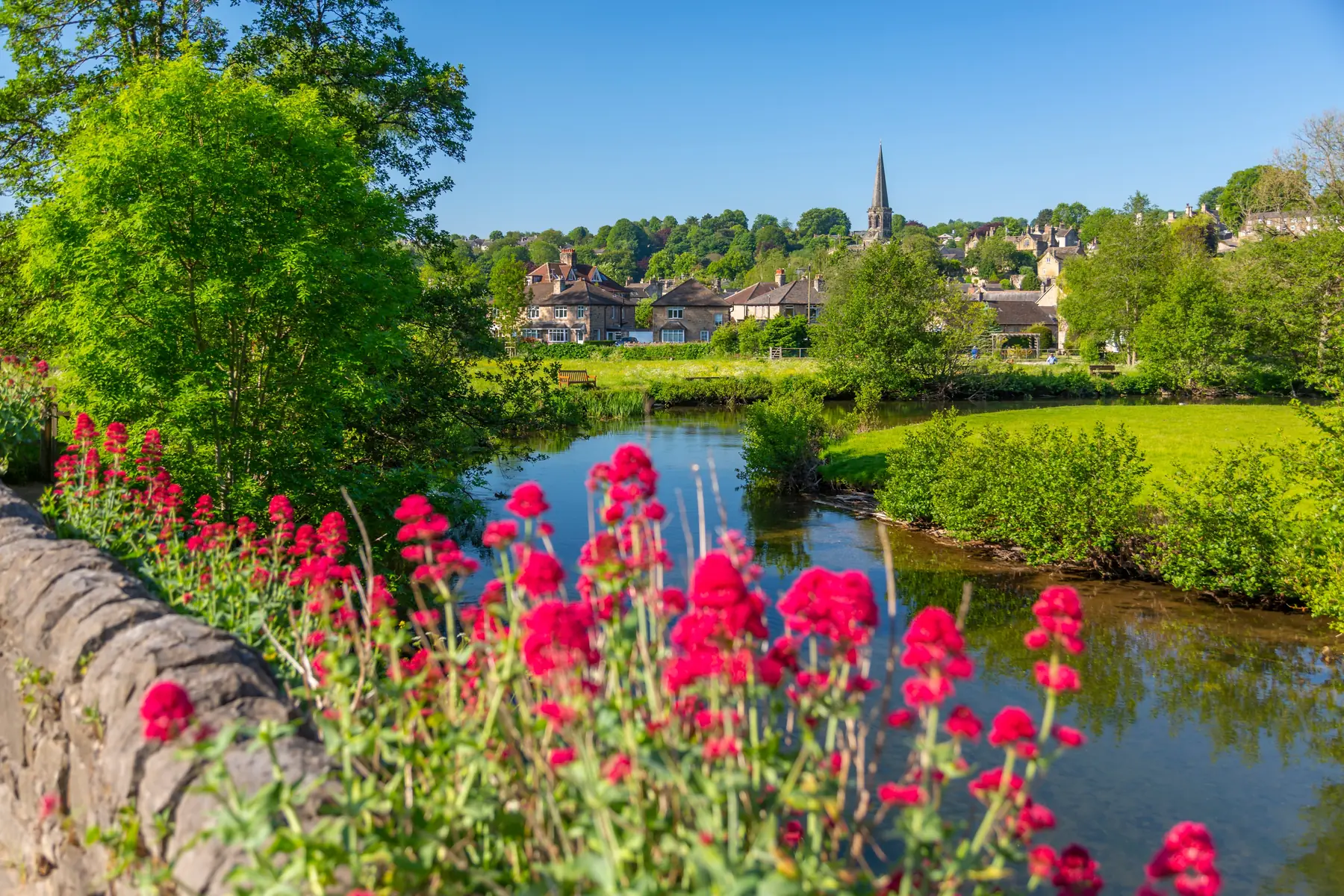
The railway through Bakewell closed in 1968, and the Peak District got something better out of it than it lost. The Monsal Trail runs along the old Midland Railway trackbed for around thirteen kilometres from Bakewell’s former station west to Blackwell Mill near Buxton, level the whole way, surfaced, traffic-free, and passing through four tunnels and over two of the finest railway viaducts in England.
It is the most accessible serious walk in the Peak District, the region’s best family bike ride, and the only route here that a wheelchair user can do for miles at a stretch. It is also, in a landscape of steep dales and hard climbs, an unusually easy way to see some genuinely dramatic scenery.
The trail begins at Bakewell’s old station, a short walk uphill from the town centre, where there is a car park and a café. From there it runs north-west above the town, then swings west into the Wye valley.
Hassop Station, a couple of kilometres out, is the first stop: a restored station building with a bookshop, café and cycle hire, and one of the busiest points on the trail.
Beyond it the valley narrows. The trail crosses the Headstone Viaduct below Monsal Head — five arches, seventy feet above the Wye, and the view down onto it from the road above is the image that sells the Peak District. The viaduct was fiercely opposed when it was built; John Ruskin was among the objectors, and the argument about whether the railway ruined the valley or gave it its finest structure has never entirely ended.
West of the viaduct come the tunnels. Headstone, Cressbrook, Litton and Chee Tor tunnels were sealed for decades after the line closed and were reopened in 2011, and passing through them is much of the pleasure of the trail — each is several hundred metres long, lit, cool and slightly unnerving.
Between them the trail runs through Monsal Dale, Cressbrook Dale and Miller’s Dale, past mills, lime kilns and the great limestone cliffs of Chee Dale, ending at Blackwell Mill where the Wye valley opens towards Buxton.
This is the Peak District’s family bike ride. The surface is good, the gradient is negligible, there is no traffic, and thirteen kilometres each way is well within reach of most people — with the option of turning round at any point.
Cycle hire is available at both ends and at Hassop Station, including tandems, trailers, adapted cycles and electric bikes. Booking ahead in the school holidays is sensible.
Two habits make the ride better. Ride west first so that the gentle gradient works in your favour on the way home, and take lights — the tunnels are lit but not brightly, and a front light is required by the trail’s own guidance in some conditions.
Most people walk sections rather than the whole thing. The three obvious ones:
Bakewell to Hassop Station and back — about five kilometres round trip, flat, with a café and bookshop at the turn. The easiest introduction.
Monsal Head to the viaduct and Cressbrook — park at Monsal Head, walk down to the trail, over the viaduct and through Headstone Tunnel, and back up. About an hour and a half with one steep climb, and it takes in the best view on the route.
Miller’s Dale to Chee Dale — the wildest section, with the option of dropping off the trail onto the riverside path and the Chee Dale stepping stones, where the path runs along the base of a cliff on stones set into the Wye. That section is impassable when the river is high and is not suitable for anyone unsteady on their feet, but it is one of the most memorable short walks in England. See our Chee Dale page.
Bakewell old station — car park, café, closest to the town.
Hassop Station — car park, cycle hire, café and bookshop.
Monsal Head — car park and pub at the top of the hill; a steep path down to the trail.
Miller’s Dale — the old station, with a car park, in the middle of the best scenery.
Wyedale and Blackwell Mill — the western end, nearest Buxton.
All the car parks charge. Several of them fill by mid-morning on summer weekends, and Hassop in particular is busy.
The trail is one of the few genuinely accessible long routes in a national park. The surface is compacted and even, the gradient is slight, the tunnels are lit and the trailheads have parking and facilities. Adapted cycles are available for hire. It is not perfectly flat and it is not uniformly smooth, but it is far better than anything comparable in the Peak District, and a great many wheelchair users and families with pushchairs use it as a matter of course.
The dales the trail passes through are limestone nature reserves. Look for orchids and other limewort flowers on the cuttings in early summer, dippers and grey wagtails on the Wye, peregrines on the Chee Dale crags, and the remains of the industry the railway was built for — lime kilns at Miller’s Dale, mill buildings at Cressbrook and Litton, and the quarry faces above the line.
The trail’s great strength is that it gives every walk in the Wye valley a flat return leg. Climb up to Monsal Head for the view and come back along the trail. Drop into Monsal Dale and walk the river. Take the path up to Ashford in the Water and return on the trackbed. Our walks guide sets out the options.
Length. Around thirteen kilometres one way, Bakewell to Blackwell Mill.
Time. Three to four hours to walk one way; an hour and a half to cycle it.
Tunnels are open during daylight hours and are gated outside them.
Dogs are welcome and the trail is very popular with dog walkers; keep them under control around cyclists.
Facilities are at Bakewell station, Hassop and Miller’s Dale. There is nothing in the middle sections.
Getting there without a car. Buses to Bakewell from Sheffield, Chesterfield, Derby, Matlock and Buxton stop around The Square, ten minutes’ walk from the trailhead. See our getting here page.
The route was built by the Midland Railway in the 1860s as part of the main line from London to Manchester, and it was one of the most expensive stretches of railway in the country to construct — the Wye valley is a gorge for much of its length, which is why there are four tunnels and two major viaducts in thirteen kilometres.
The line’s arrival provoked one of the most quoted rows in the history of British conservation. John Ruskin, who loved the valley, wrote furiously about what the railway had done to Monsal Dale, and his objection has been rehearsed by every generation since. The irony is not lost on anyone who now stands at Monsal Head photographing the viaduct, which is generally agreed to be the finest thing in the view.
The line closed in 1968 under the Beeching cuts. The trackbed lay unused for years, the tunnels were sealed, and the Peak District National Park Authority opened the first sections as a trail in the early 1980s. The tunnels stayed closed until 2011, when a major project reopened all four and turned a series of disconnected fragments into the continuous route that exists now.
The trail is at its best walked or ridden one way, and there are two ways to arrange that. The simplest is two cars, one left at each end. The other is the bus: services between Bakewell and Buxton run along the A6 through the valley, which shadows the trail, so you can ride or walk west and catch a bus back. Check the timetable before you set out rather than after, since the frequency drops on Sundays.
About thirteen kilometres from Bakewell to Blackwell Mill, or twenty-six there and back.
Yes. Four tunnels were reopened in 2011 after decades sealed, and they are lit and open during daylight hours.
At Bakewell’s old station, Hassop Station and the western end near Blackwell Mill, with adapted cycles, tandems and trailers available.
Yes, for most of its length — it is one of the most accessible long routes in any British national park.
They are lit, but a front light is strongly advised for cycling and is expected in some conditions.