Haddon Hall stands on a wooded rise above the River Wye, two miles south of Bakewell on the A6, and it is not Chatsworth. That is the first thing to get straight, because the two houses sit in the same few kilometres of Derbyshire, they are both extraordinary, and they have almost nothing else in common.
Chatsworth is a baroque palace with a park by Capability Brown. Haddon is a medieval manor that was never rebuilt for later fashion. Pevsner called it “the most complete and most interesting house of its period.” The line gets quoted. It is earned.
Chatsworth is four and a half kilometres north-east of Bakewell, the Cavendish family, Dukes of Devonshire, state rooms, a cascade, a farmyard and a thousand acres of free parkland. It is the most visited place in the Peak District. It should be.
Haddon is the counterweight: smaller, older, still lived in by the Manners family, and largely unrestored in the Georgian sense. You do not go from one to the other as if they were rooms in the same museum. You do both, on different days if you can, and you let each one be itself.
The houses are not interchangeable on a wet afternoon. Chatsworth has hours of indoor state rooms. Haddon is a courtyard house: you move between buildings, some of the visit is outdoors, and the gardens are terraces down to the river. Check the season before you drive.
The site is eleventh-century in origin. The Peverels held it after the Conquest; the Vernons held it through the later Middle Ages; Dorothy Vernon married John Manners in the sixteenth century, and the Manners — later Dukes of Rutland — have held it since.
The reason the house survives as a medieval and Tudor building is that the family left. In the early eighteenth century the Dukes made Belvoir Castle in Leicestershire their principal seat. Haddon was not demolished, not Georgianised, not given a new facade. It was shut up, lived in lightly, and left. For two hundred years the plaster stayed, the windows went out of true, and fashion passed it by.
When the ninth Duke began restoring it in the 1920s, what he restored was the house that had simply stopped. You are not looking at a Victorian idea of the Middle Ages. You are looking at a house that missed the centuries that would have improved it. Lord Edward Manners and his family live here.
The buildings enclose courtyards. From the outside it reads as a small fortified village rather than a country house: gatehouse, tower, chapel, ranges, all of different dates between the thirteenth century and the seventeenth, latterly Tudor.
The Banqueting Hall is the fourteenth-century heart of it. A screens passage, a minstrels’ gallery, a dais, a long oak table. The scale is domestic by palace standards and grand by manor ones.
The kitchens beyond are among the best-preserved medieval domestic kitchens in England. Chopping blocks worn into hollows, salting troughs, fireplaces you can stand up in. They have not been dressed as a display of “how we used to cook.” They are the rooms.
The chapel holds fifteenth-century wall paintings, uncovered under limewash, and it sits in the courtyard as part of the house rather than as a parish church down the drive.
Floors are uneven. Doorways are low. There is no lift. The house is honest about that; the accessibility statement is the document to read if steps are a question. The lower courtyard and parts of the garden are more manageable than the upper rooms.
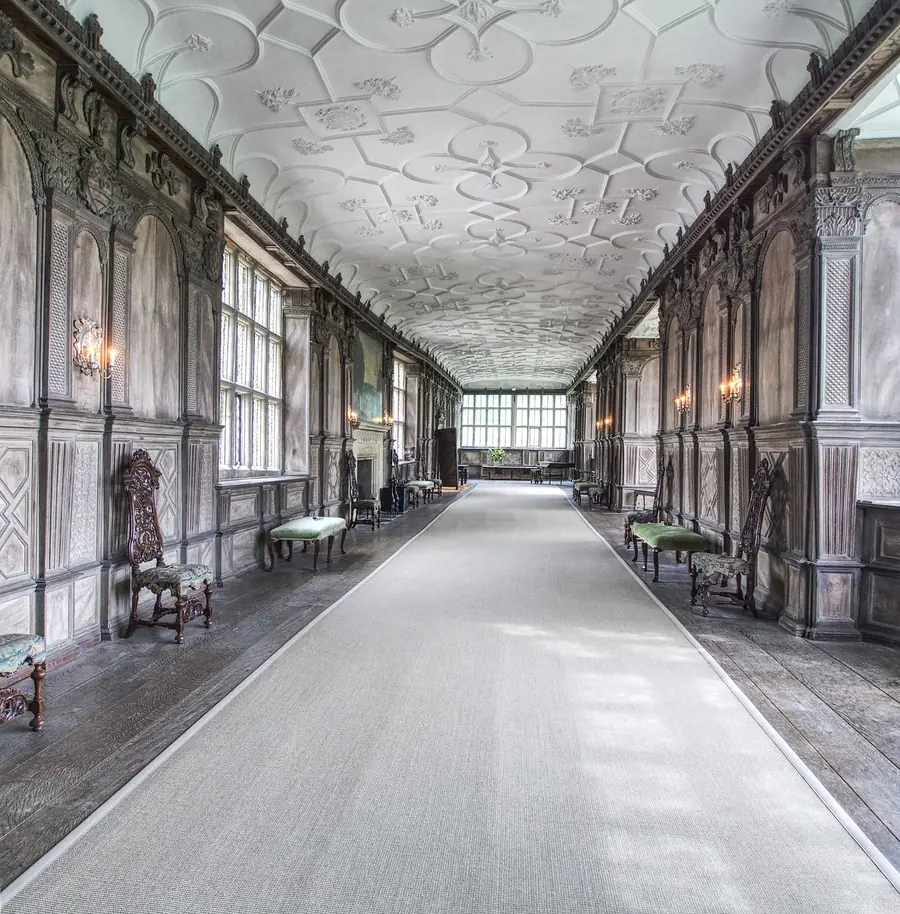
The Elizabethan Long Gallery is the room people remember, and it is the room in the photograph at the top of this page.
It runs about 110 feet, panelled, plastered, with leaded windows that are visibly out of true because the building has settled. Light comes in along one side. The floor is not flat. It is generally reckoned one of the loveliest rooms in the country, and for once the guidebook line is not an exaggeration. You walk it slowly. That is the correct speed.
It was added in the later sixteenth century, when a medieval house wanted a place to walk in wet weather. Fashion then moved on. The gallery did not. The windows still look over the terraces toward the Wye. Allow time in here.
The gardens are terraced, dropping in stages from the house to the Wye, with roses, clipped yew and a seventeenth-century balustrade. They were laid out to be walked in rather than looked at from a window. The famous view is from the bottom of the steps looking back up at the house, with the packhorse bridge over the river below.
They are formal without being grand. Chatsworth’s garden is a hundred and five acres of four centuries of fashion. Haddon’s is a set of walled and terraced rooms on a slope. They are not the same afternoon.
The Wye at the foot of the gardens is the same river that runs through Bakewell. The bridge and riverside piece is that water in the town; here it is a boundary. A public footpath runs near the hall. There are no public footpaths through the parkland — check an OS map. The estate runs guided walks in that park; those are booked events, not a right of way.
The story everyone tells is that Dorothy Vernon, daughter of Sir George Vernon, “King of the Peak,” slipped away from a ball in the 1560s and eloped with John Manners over the packhorse bridge. The marriage is real. The midnight flight is the later romance, and the house has lived with it for a long time. You will be shown the steps. You do not have to believe every panel.
What is not legend is the completeness. Haddon’s survival has made it one of the most-filmed houses in Britain: several versions of Jane Eyre, Elizabeth, The Princess Bride, The Other Boleyn Girl, among a long list. If a courtyard, a gallery or a chapel looks familiar, that is why. Come for the house. The films are a footnote that explains the sense of recognition.
On foot from Bakewell is the best arrival. About three kilometres south along the Wye, leaving town by the Recreation Ground. Around forty minutes. The house appears across the meadows. The hall has sold a “Green Adult” ticket for people who arrive by public transport or on foot — check the current tariff on the visit page, because concessions move.
By car: on the A6 between Bakewell and Rowsley, two miles (3.2 km) south of Bakewell. Own parking. Do not use Bakewell’s Agricultural Business Centre and drive on; that is two parks and the same traffic twice. Our parking guide is blunt about this.
The hall’s car park is on the opposite side of the A6 from the house. Route to the park, not to the hall — the visit page gives DE45 1LA for the car park — or you may be sent down a track. A late-2026 snapshot had a per-car charge at the exit barrier; confirm on the board. The walk from the park to the hall is a few hundred metres, with gravel and steps, and a busy crossing. Overflow goes into a field on event days.
By bus: Transpeak and the 6.1 between Matlock and Bakewell stop at the gate. From Bakewell the ride is a few minutes. Frequencies change; check the day you travel. The car-free guide and the getting here page are the rest. There is no station in Bakewell; Matlock is the useful one from Derby, then the bus.
Haddon opens for a defined season, not all year. The 2026 main season on the hall’s own visit page ran from late March to early October, with a closure in mid-October and special events after that, including Christmas. Hall and garden hours, last entry, restaurant hours and ticket prices sit on haddonhall.co.uk/visit. They move. Do not treat this paragraph as a timetable.
Christmas at Haddon is a substantial event: the hall dressed, stalls in the courtyard. Book it as itself. Do not assume the ordinary visitor route is running in December. Time: two hours for house and gardens, longer at Christmas.
Dogs are not allowed in the hall, gardens or grounds, other than guide and support dogs. There is a public footpath opposite the hall. Large rucksacks and tripods have not been allowed into the hall; check the current rule. The restaurant in the seventeenth-century stable block has been open to ticket holders and to the public.
Do not try to do Haddon and Chatsworth as a single morning. They are different tickets, different car parks, different centuries.
A day that works: Bakewell early — the bridge, the Square — then the riverside walk to Haddon. Bus back, or walk. Chatsworth on a different day, by bus from The Square. The day trips piece has the wider map.
Haddon is the finest medieval house in this part of England, two miles from a town that most visitors treat as a car park for Chatsworth. Give it the afternoon it is for. Check haddonhall.co.uk the night before.