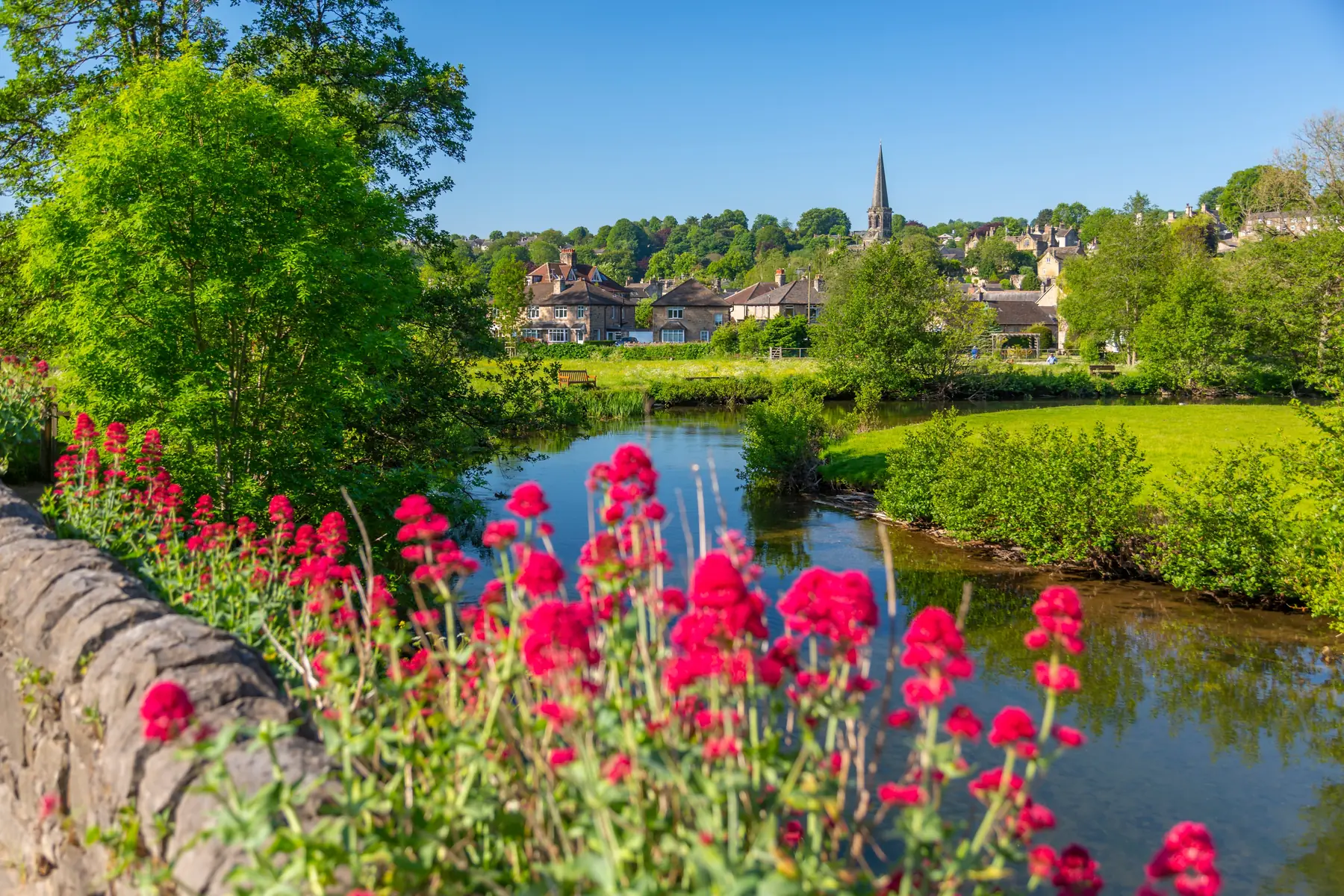
Bakewell is the only town inside the Peak District National Park and it sits almost exactly in the middle of it, which makes it the best base in the region for days out. Everything in the White Peak is within twenty minutes; the gritstone edges and the caverns of the Hope Valley are within half an hour; Sheffield, Derby and Manchester are all reachable for a day.
The park is small and the roads are not. Peak District lanes are narrow, walled and busy at weekends, and the A6 through the Wye valley can crawl. Times below are honest rather than optimistic.
Four and a half kilometres north-east. The house, the garden, the farmyard and the adventure playground could occupy two days, and the park is free and open to walk in. This is the single most-visited place in the Peak District and it earns it. Several bus routes from Bakewell pass the gates, which makes it easy without a car.
Three kilometres south, and the perfect counterweight to Chatsworth — medieval rather than palatial, small enough to see properly, and largely unrestored. Walk there along the Wye if the weather allows.
Eight kilometres north. The plague village, which in 1665 chose to quarantine itself rather than let the infection spread, at enormous cost. The museum tells it well, the plague cottages and the Riley Graves are outdoors and free, and Eyam Hall’s courtyard has shops and a café. It is a short visit with a long afterlife.
Four kilometres north-west. A limestone village with the Sheepwash Bridge — a packhorse bridge with a walled pen beside it where sheep were washed before shearing — a good tea room and a serious dining pub. Twenty minutes’ worth of village, and worth every one.
Ten kilometres north-west. Home to St John the Baptist’s, a fourteenth-century church so ambitious it is known as the Cathedral of the Peak, in a village of a couple of thousand people.
The White Peak villages south and west of Bakewell, each with a pub and each at the head of a dale. Combine one with a walk.
Twenty-two kilometres west. A Georgian spa town with the Crescent, the Pavilion Gardens, an opera house and the highest market place in England. It is a proper town rather than a village, with shops and a season of festivals, and it is the obvious wet-day city fix.
Twenty-five kilometres north-west. Four show caverns — Speedwell, with its underground boat trip; Peak Cavern; Treak Cliff; and Blue John, where the ornamental stone is still mined — plus Peveril Castle above the village and the great gash of Winnats Pass. Mam Tor, the shivering mountain, is the walk. It is the busiest corner of the Peak District in summer for good reason.
Thirteen kilometres south. A Victorian spa resort in a steep gorge that reinvented itself as an inland seaside town, with amusement arcades, an aquarium, fish and chips and, above it, the Heights of Abraham — reached by cable car, with show caverns, a playground and a viewpoint. Gulliver’s Kingdom is on the same hillside. Strange, cheerful and thoroughly enjoyable.
Fourteen kilometres south. Cromford Mills is Richard Arkwright’s first water-powered cotton mill and the birthplace of the modern factory, now a World Heritage Site with exhibitions and cafés. The Cromford Canal and High Peak Junction are free to walk, and Black Rocks above the village is a gritstone outcrop with a place in the history of British rock climbing.
Thirteen kilometres north. Hathersage has Little John’s grave in the churchyard and a lido; above it, Stanage Edge is the most famous gritstone escarpment in England, six kilometres of climbing and one of the great Peak District walks.
Sheffield is twenty-four kilometres north-east — under an hour by bus, with museums, galleries and a city’s worth of shopping. Derby is an hour and a half south by the Transpeak bus. Manchester is around an hour and a half by road, or reachable by train from the Hope Valley line stations. Chesterfield, with its crooked spire, is half an hour east.
Lincoln, Nottingham and the Yorkshire Dales are all possible as long days but better as separate trips.
Bakewell has had no railway since 1968, when the line through the town closed — a decision the critic John Ruskin, who had objected furiously to the railway’s arrival in 1862, would have enjoyed. The nearest stations now are Grindleford and Hathersage on the Hope Valley line between Sheffield and Manchester, and Matlock on the line from Derby, all around eleven kilometres away.
The buses, though, are good. Frequent services run from Sheffield via Baslow, several of them calling at Chatsworth; an hourly service comes from Chesterfield via Baslow and Chatsworth; and the Transpeak links Derby, Matlock, Bakewell and Buxton hourly. A slower Sheffield route takes ninety minutes and calls at Hope, Hathersage, Calver and Eyam, which turns the bus itself into a sightseeing trip. There is no bus station — the stops are around The Square.
For arrival routes in detail, see our getting here page.
The estates day. Haddon Hall in the morning, three kilometres south, then north to Pilsley for the Chatsworth farm shop and lunch, and Chatsworth itself in the afternoon. Under fifteen kilometres of driving in total and two of the finest houses in England.
The Hope Valley day. North to Eyam for the plague village and the museum, on through Hathersage below Stanage Edge, then to Castleton for a cavern and Winnats Pass, returning over the tops via Baslow. A full day, a lot of variety, and the best driving in the Peak District.
The Derwent Valley day. South through Rowsley and Matlock to Matlock Bath for the cable car and the Heights of Abraham, then Cromford Mills and the canal, and back via Winster and Youlgreave. Industrial history, Victorian seaside and White Peak villages in one loop.
The Peak District’s roads were built for carts and the traffic is not. Summer weekends clog the A6 through the Wye valley and the routes into Castleton and Matlock Bath, and the car parks at the honeypots — Monsal Head, Castleton, Matlock Bath, Chatsworth — fill by mid-morning. An early start is worth more here than in most places, and going midweek is worth more still.
Bakewell’s own calendar should shape the week. Monday is market day — the town is at its liveliest and its most congested, and it is a good day to be in Bakewell and a bad day to try to park in it late. Weekends push everyone towards the honeypots: Castleton, Matlock Bath, Chatsworth and Monsal Head all fill. Midweek out of season is when the Peak District is at its best, and when the villages, the dales and the edges are as close to empty as they get.
If you have a fixed week here, the pattern that works is: the big houses midweek, the quiet dales and edges at the weekend when everyone else is queueing at the caverns, and the town itself on market day.
Chatsworth if you have one day. Castleton and the Hope Valley if you want caves and hills. Eyam if you want the story.
Four and a half kilometres, about ten minutes by road, with buses passing the gates and a walking route across the estate.
Yes, though it takes longer than the distance suggests — the slower Sheffield route runs via the Hope Valley.
Yes, particularly in poor weather: the Crescent, the Pavilion Gardens and the opera house are all indoors or under glass.
Twenty-four kilometres north-east, and around an hour by bus from The Square.