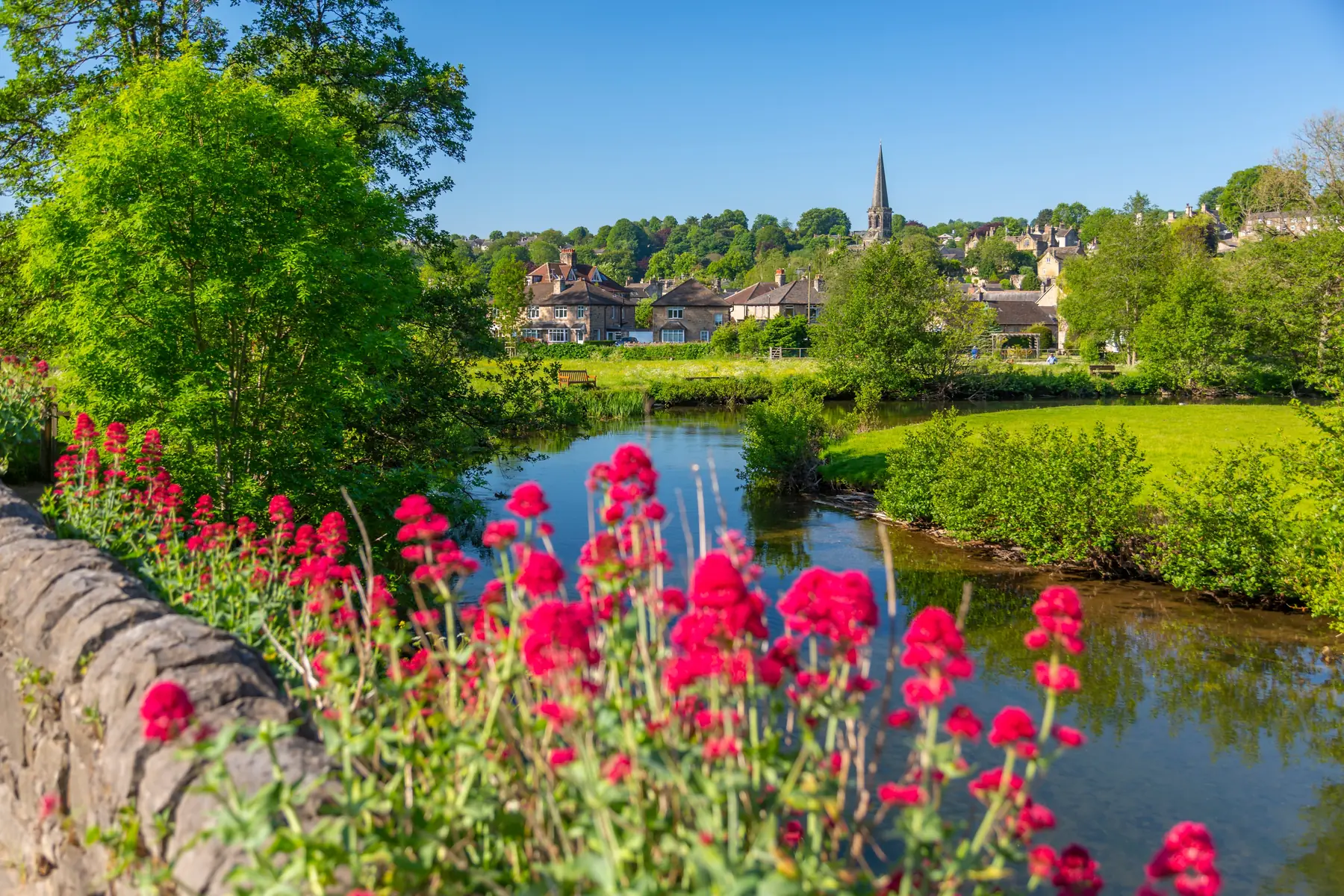
Bakewell can be an expensive day out if you let it be. Chatsworth, Haddon Hall, the caverns and the theme parks all charge, and a family working through them will spend a great deal. But the town is inside a national park, and the national park is free. The dales, the edges, the old railway, the stone circles, a ruined lead mine and one of England’s greatest parklands are all available for nothing.
Here is the free version of a Bakewell trip.
The riverside. The Wye runs through the middle of Bakewell, and the walk from the medieval bridge past the weir and the footbridge to the Recreation Ground is the town’s best free half-hour. There are ducks, there is the weir, and there is the view back up to the church.
All Saints Church. Free to enter and unusually rewarding: a Saxon cross in the churchyard, a remarkable collection of Anglo-Saxon and Norman carved stones, and the Vernon and Manners monuments.
Bath Gardens, off Rutland Square, is a small formal garden in the middle of town, and the Recreation Ground by the river has open space and a play area.
The market. Monday is market day, and both the general market in the town and the livestock market at the Agricultural Business Centre are free to walk round. The livestock market is a working agricultural market rather than a visitor attraction, which is precisely what makes it worth seeing.
The visitor centre in the Old Market Hall on Bridge Street is free, and the building itself is seventeenth century.
The house and garden are ticketed. The park is not. Several hundred acres of Capability Brown parkland along the Derwent, with sheep and deer, the bridge, the mill ruin, and the house rising above it — you can walk in from Baslow, Pilsley or Calton Lees and spend a whole day without paying anything but for parking. It is one of the finest free walks in England and a surprising number of visitors never realise it is open.
Thirteen kilometres of former railway, level and surfaced, running west from Bakewell’s old station through four lit tunnels and over the viaducts at Monsal Head and Miller’s Dale. Free to walk, free to cycle if you have your own bike, and accessible for wheelchairs and pushchairs along most of its length. The view from Monsal Head down onto the Headstone Viaduct is the Peak District’s signature image, and it costs nothing. Our Monsal Trail guide has the detail.
Lathkill Dale, five kilometres west, is a National Nature Reserve — a clear limestone river in a steep wooded valley, exceptional for wildflowers in early summer, and free to walk. Start at Over Haddon.
Bradford Dale below Youlgreave has a chain of clear pools and low weirs and is quieter than Lathkill.
Chee Dale, ten kilometres west, has the stepping stones set along the base of a cliff where the path runs out of room. Free, dramatic, and impassable when the river is high.
Deep Dale, near Sheldon, is a Plantlife reserve and one of the best limestone flower sites in the country.
Magpie Mine, four and a half kilometres west near Sheldon, is the best-preserved lead mine in Britain — engine house, chimney and headgear standing on the open plateau, a Scheduled Monument, and free to walk around at any time.
Robin Hood’s Stride, six kilometres south, is a pair of weathered gritstone pinnacles on the Limestone Way, with the Hermit’s Cave nearby.
Stanton Moor holds the Nine Ladies stone circle among birch woods and heather, along with dozens of Bronze Age cairns. Free and open.
Birchen Edge, Gardom’s Edge and the Eagle Stone on Baslow Edge are all open access, all free, and all give the long eastward views that the White Peak lacks. Gardom’s Edge has prehistoric rock art if you know where to look.
The Sheepwash Bridge at Ashford in the Water, four kilometres north-west, is a packhorse bridge with a walled sheep enclosure beside it — free, photogenic and two minutes from the car.
Ashford in the Water, Over Haddon, Youlgreave, Monyash and Tideswell — the last of these with a church so large it is called the Cathedral of the Peak — all cost nothing to walk round and all have a pub if you change your mind about the budget.
Eyam, eight kilometres north, can be done free: the plague cottages, the church, the Riley Graves and the boundary stone are all outdoors and open, even if the museum is not.
Honesty about the one unavoidable cost: parking. Bakewell’s car parks charge, and so do the trailhead car parks at Over Haddon, Monsal Head and Miller’s Dale. The way round it is to arrive by bus — services run frequently from Sheffield, Chesterfield, Derby, Matlock and Buxton, stopping around The Square, and several pass Chatsworth. A car-free day here is entirely workable and removes the largest expense.
Walk the riverside and the church in the morning, then take the Monsal Trail west from the old station as far as Monsal Head — about five kilometres, level, through the tunnels — and climb up to the viewpoint for lunch. Come back down the trail or drop into the dale and walk the river. In the afternoon, take the path south to Haddon Hall and look at it from the meadows, then follow the Wye back into town. A full day in a national park, and you have spent nothing.
A note for members. The area around Bakewell is unusually well supplied with properties: Hardwick Hall, one of the great Elizabethan houses, and Sudbury, Kedleston and Ilam Park are all within reach for National Trust members, and Peveril Castle at Castleton is English Heritage. None of them is in Bakewell itself — Chatsworth and Haddon are both privately owned and not covered by either membership — but if you already hold one, it changes what a week here costs.
Bakewell’s calendar carries several things that cost nothing to watch. The Monday market runs year-round. Well dressing, the Derbyshire tradition of decorating wells with pictures made from flower petals pressed into clay, takes place across the villages through the summer — Tideswell, Youlgreave, Ashford and Bakewell all dress wells, and the boards stay up for a week. The Bakewell Show, one of the oldest agricultural shows in the country, is ticketed, but the town around it is not.
Well dressing in particular is worth planning a visit around. It is genuinely local, genuinely old, and free.
England’s access arrangements are more limited than Scotland’s, but the Peak District is the exception that proves the point — it was the first national park in Britain, designated in 1951, and it exists in large part because of the mass trespass on Kinder Scout in 1932 and the campaign for access that followed.
The practical result around Bakewell is a dense network of public footpaths and bridleways, plus large areas of open access land on the moors and edges. The dales, the edges, the stone circles and the old mines are all reachable on rights of way, and the Peak District National Park Authority maintains them well. A decent map, or the park authority’s own route leaflets from the visitor centre in the Old Market Hall, will keep you busy for a fortnight without spending anything.
Yes. The park is open and free to walk in; the house, garden and farmyard are ticketed. Parking is charged.
Yes, it is open at all reasonable times with no charge, though it is a ruin on open ground rather than a managed attraction.
The riverside, All Saints Church, Bath Gardens, the Recreation Ground and the Monday market.
Free to walk and cycle. Only parking at the trailheads is charged.
Yes. Buses from Sheffield, Chesterfield, Derby, Matlock and Buxton are frequent and stop in the middle of town.